


The Medicare EP’s are as follows:
- Doctor of Medicine or Osteopathy
- Doctor of Dental Surgery or Dental Medicine
- Doctor of Podiatric Medicine
- Doctor of Optometry Chiropractor
EP’s can also qualify for the EMR incentive program through Medicaid if they see less than 90% of their patients in a hospital setting and more than 30% of their patients are Medicaid (20% for Pediatricians). The Medicaid EP’s are as follows:
- Physicians
- Nurse Practitioners
- Certified Nurse
- Midwives
- Dentists
- Physician Assistants (working in a Federally Qualified Health Center or rural health clinic that is so led by a PA)
- All medical entities that handle Protected Health Information as defined by HIPAA need to be compliant with HIPAA regulations to avoid penalties and liability
The general benefits of an EMR are easier to manage patient files. Paper records are bulky and take up costly space. Filing, retrieval of files and the re-filing of paper records are very labor intensive methods with which to store patient information. Plus if a record is checked out for one department another department can’t access the chart. The impact of not having immediate access to key information in emergency situations can be serious. Paper medical charts also cannot be effectively searched and used to track, analyze and/or chart voluminous clinical medical information and processes. They cannot be easily copied or saved off-site. Physician’s orders and the corresponding results (meds, labs, etc.) can also be issued, saved and maintained much more efficiently in a comprehensive EMR system.
Maintaining HIPAA compliance is mandatory for any covered entities handling PHI. Having HIPAA compliant policies in place will significantly reduce the chance of a breach event occurring. In the event that a breach does occur the policies and adherence to those policy strongly influences what penalties may be imposed. Such policies not only protect the provider HIPAA penalties, but can also help to reduce liability for breach events.
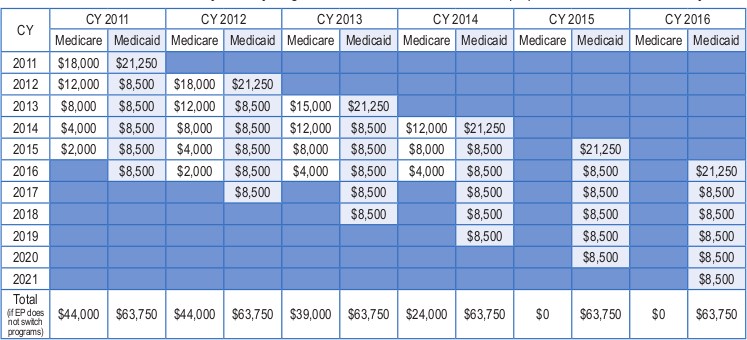
If an EP chooses not to become compliant before 2015 they will not only miss out on the grant program but will also start to incur Medicare payment penalties. Starting in 2015 Medicare payments will be reduced by 1% per year up to 3% in 2017. Further penalties may be implemented after 2017.
The consequences of not being HIPAA compliant can be much more immediate and severe. In the past penalties were capped at $1.5 million per calendar year. Recently enacted laws seek to increase the penalty cap to $1.5 million for all violations of an identical provision. A new four tier penalty system has been introduced. A covered entity can no longer bar the imposition of a civil money penalty for an unknown violation unless it corrects the violation within 30 days of discovery.